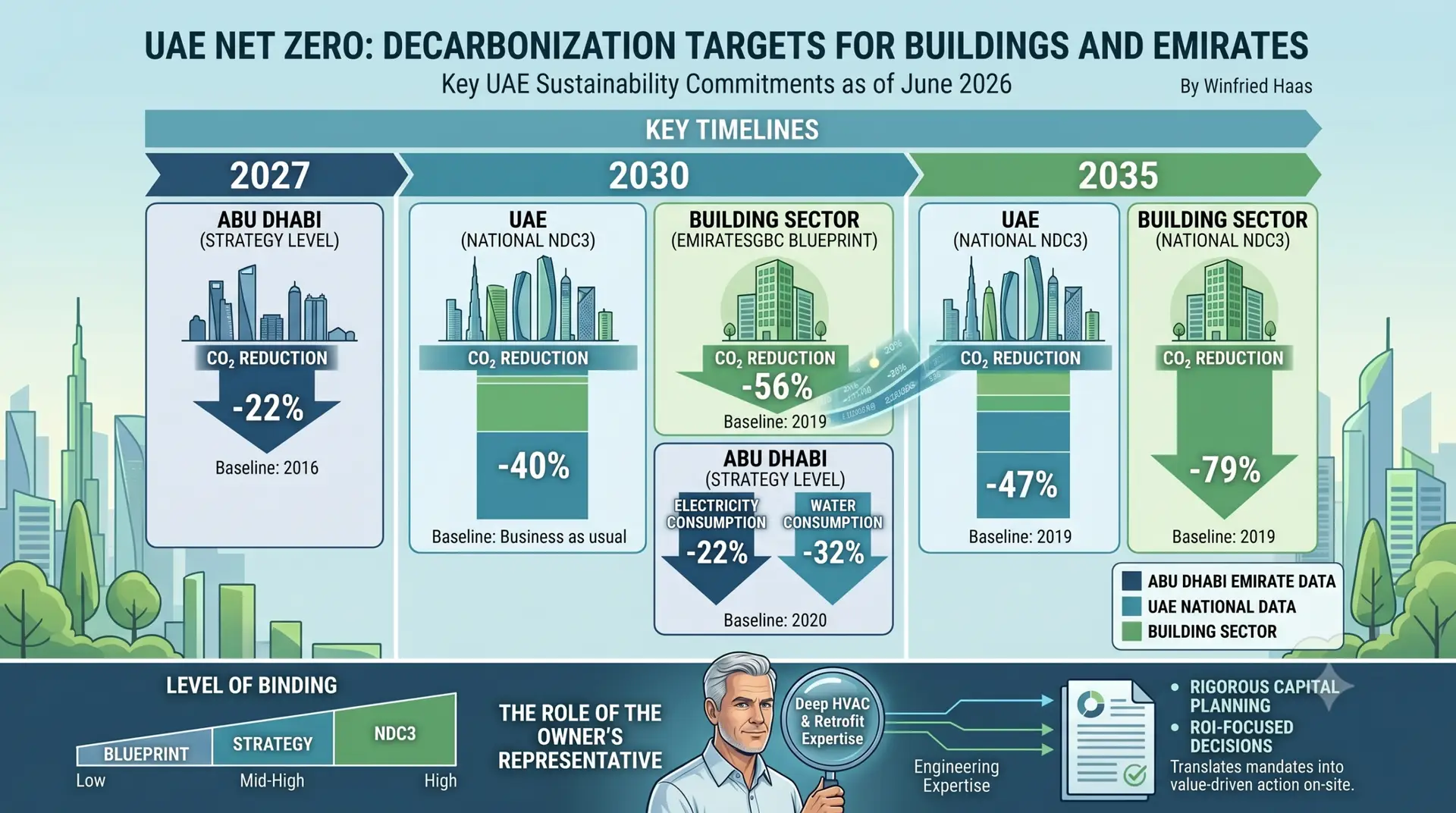
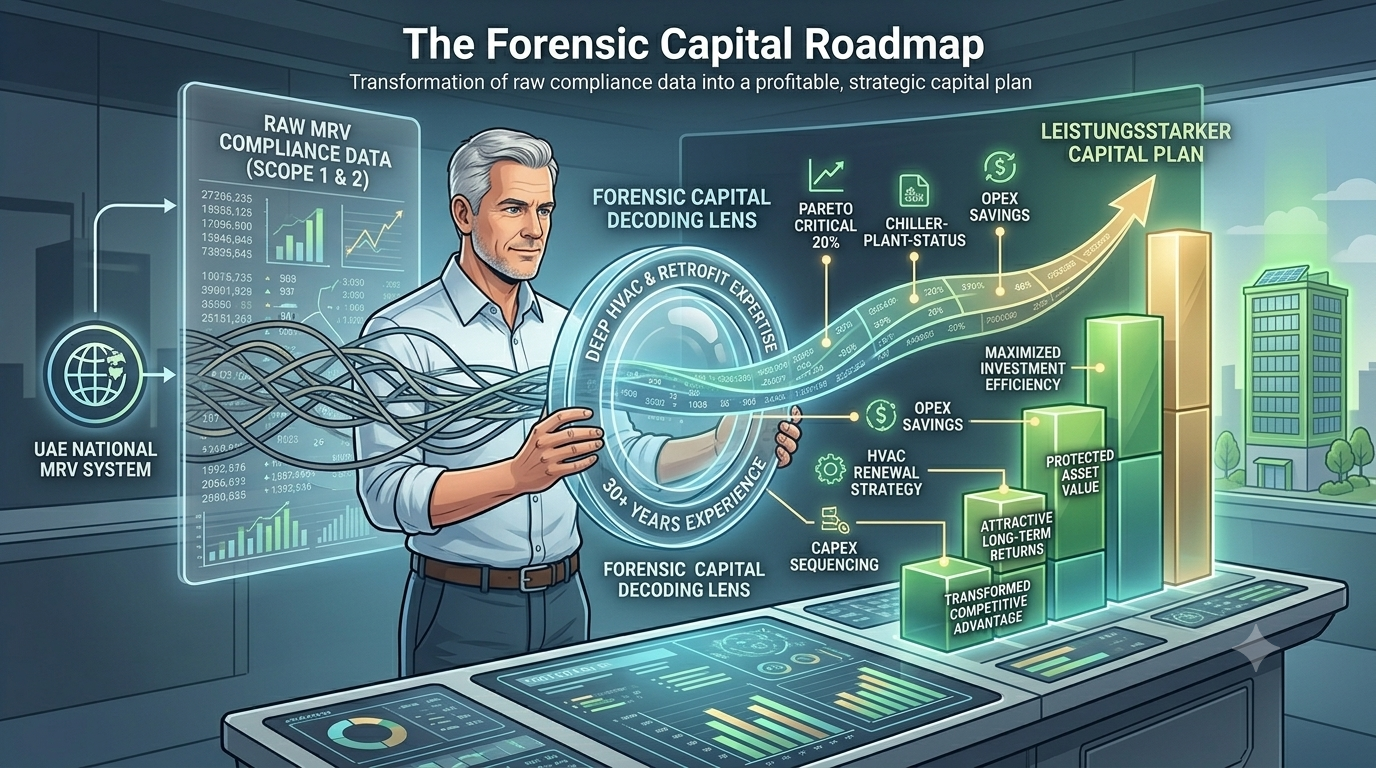
Context & Mandate In 2009, the Abu Dhabi Water and Electricity Authority (ADWEA, now Department of Energy – DoE) commissioned a sovereign-scale consultancy assignment to architect the Emirate’s first structured Demand-Side Management (DSM) framework. The mandate was to transform a vast building portfolio into a prioritized, bankable roadmap for energy reduction.
Executive Leadership & Role Winfried Haas, founder of HAAS Sustainable Consulting, served as the Lead Consultant and Head of the DSM Module (delegated by the parent organization of a leading German ESCO). He directed an international engineering task force on-site, providing the technical and strategic oversight required to bridge the gap between high-level policy and asset-level reality.
Strategic Scope of Work
-
Portfolio Intelligence: Strategic analysis of approx. 34,000 buildings to establish a data-driven baseline.
-
Methodology Design: Development of the DSM savings logic, prioritization matrices, and emirate-wide rollout structures.
-
Asset-Level Rigor: Supervision of intensive energy audits for 200+ high-priority assets, including HVAC, lighting, and advanced control systems.
-
Investment Readiness: Identification of a 35% energy-saving potential and development of measure-level business cases and EPC-type delivery models.
The Blueprint for Success: 30% Verified Savings This strategic roadmap served as the technical blueprint for Abu Dhabi’s energy transformation. The framework’s precision was later validated in practice: In 2017/2018, the Department of Energy (DoE) implemented EPC structures for pilot buildings identified in our original study.
Result: The implementation achieved verified savings of approx. 30%—directly confirming the accuracy and defensibility of our original strategic assessments
Independence & Fiduciary Clarity
To ensure absolute transparency and avoid conflict of interest, it is important to define our structural role:
- Pure Advisory: Our role was exclusively strategic and technical. We were not the EPC contractor, nor did we execute the 2017–2018 implementation works.
- Unbiased Oversight: We did not provide savings guarantees or participate in the implementation contracts. This independence allowed us to provide the board with an unvarnished, neutral baseline for decision-making.
Relevance for HAAS Sustainable Consulting Today
This legacy engagement is the foundation of our Fiduciary Advisory approach. It demonstrates HAAS’s unique capability to identify savings potentials that withstand the scrutiny of real-world implementation.
Today, we apply this emirate-level experience to help owners of premium hotel assets combine technical depth with economic clarity. We prepare defensible decisions long before CapEx commitments are made—ensuring that your Net Zero transition is driven by data, not by vendor agendas.